


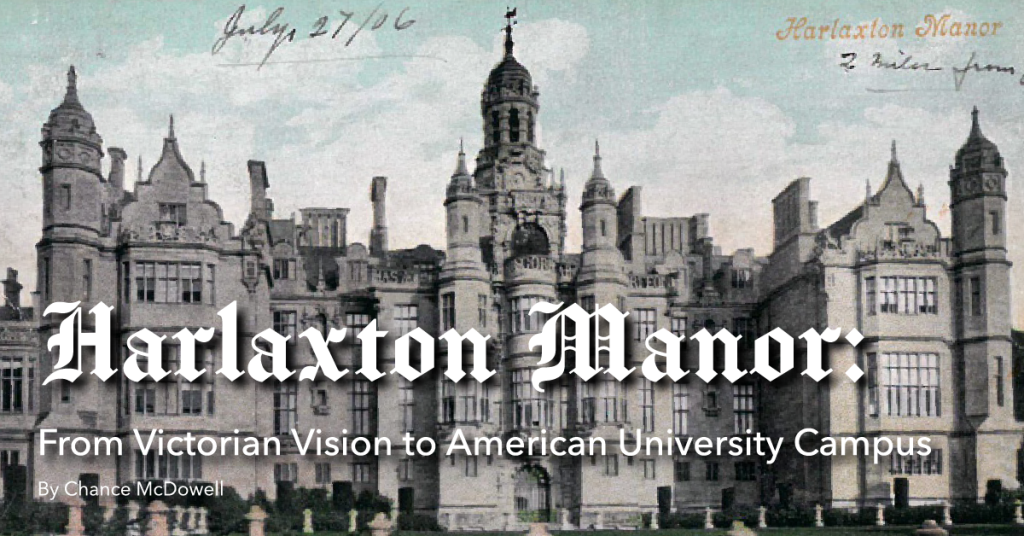
By the edge of Grantham, Lincolnshire, stands a building that seems almost too grand to belong in the English countryside. Harlaxton Manor has been a family home, wartime headquarters, religious seminary and an American university campus. Its remarkable journey is a story of ambition, changing fortunes and one university’s determination to give its students an education far beyond the classroom.
Just five kilometers (3.11 miles) west of Grantham, Harlaxton Manor dominates the surrounding landscape. With its towers, terraces, ornate stonework, elaborate gardens and dramatic combination of architectural styles, it is unlike almost any other country house in England. Today it is the British home of the University of Evansville. But the reason an American university came to own a grand Victorian manor in Lincolnshire is only the latest chapter in a history stretching back centuries
Harlaxton itself is considerably older than the present manor. Archaeological evidence indicates settlement in the area going back thousands of years, while the village appears in the Domesday Book of 1086 under the name “Herlavestune.” The Harlaxton History Society explains that the name probably derives from an Old Norse personal name combined with the Old English word tun, meaning a farmstead or settlement.
Several manor houses stood at Harlaxton before the building visitors see today. A medieval manor stood near the center of the village, and local tradition associates an earlier house with John of Gaunt, the son of King Edward III, who is said to have used it as a hunting lodge. In 1619, Daniel de Ligne, a Flemish Protestant refugee who had fled religious persecution, purchased the estate.
When Gregory Williams inherited the estate in 1822, he adopted the name Gregory Gregory. A wealthy landowner and enthusiastic collector, he had traveled in Europe and developed a fascination with art, architecture and grand country houses. He decided that Harlaxton needed a new home, one that would reflect his tastes and ambitions.
In 1831 he commissioned the architect Anthony Salvin, and construction began the following year. Salvin worked on the project until 1838, when disagreements with Gregory led to his replacement by William Burn and his partner David Bryce. Historic England dates the principal construction from 1832 to 1844, with decoration and completion continuing into the 1850s.
Harlaxton combined Elizabethan and Jacobean Revival architecture with Baroque influences. Its grand interiors incorporated architectural features and decorative objects collected from Britain and continental Europe. The Harlaxton History Society describes the house as Gregory’s “personal vanity project.” He spent years collecting furniture, tapestries, paintings, and other objects for a house that was not merely intended to be comfortable, but to be a personal architectural statement.
The cost was enormous. The History Society estimates that the house cost around £100,000 ($135,894.99), roughly £10 million ($13.6 million) in today’s money. Gregory never married and had no children, so the magnificent house he spent decades creating would soon pass to relatives.
The Gregory family remained connected with Harlaxton for generations, but by the twentieth century the great country-house era was coming to an end. In 1937, Philip Pearson Gregory decided to sell the estate.
The Manor was purchased by Violet Van der Elst, an entrepreneur, inventor and campaigner against capital punishment. She renamed the property “Grantham Castle,” although the name Harlaxton Manor eventually returned. Van der Elst made her own mark on the house, including installing electricity and adding features such as the great chandelier in the Great Hall.
The Second World War brought another dramatic transformation. The War Office requisitioned the Manor, which was used in connection with the nearby RAF station and subsequently by the British 1st Airborne Division. Harlaxton became associated with the preparations for the airborne operations of 1944, including Operation Market Garden.
After the war, Harlaxton entered an entirely different phase of its history. In 1948, the Society of Jesus (the Jesuits) purchased the Manor and used it as a training center for novice priests. The building that had once symbolized Victorian wealth was now serving a religious and educational purpose.
And that educational role would ultimately lead to Harlaxton’s most unusual chapter.
During the 1960s, American universities were becoming increasingly interested in providing students with educational experiences overseas. The Jesuits leased Harlaxton to Stanford University in California in the mid-1960s, establishing an early American university presence in Britain.
Under President Wallace B. Graves, UE took over the sublease in the early 1970s. The first University of Evansville students arrived at Harlaxton in 1971. Rather than treating Britain as simply a destination for occasional trips, the university developed Harlaxton as a genuine overseas study center where students could live and study together.
Students could study British history, politics, literature, and culture while living within an historic English estate. They could visit London and other parts of Britain, travel elsewhere in Europe, and experience the difference between reading about another culture and living within it.
By the early 1970s, UE had already demonstrated that Harlaxton could work as an overseas study center. The question was whether the university should make that relationship permanent. The answer came partly through the enthusiasm of one individual: Dr. William L. Ridgway, a University of Evansville trustee.
According to the University of Evansville, Ridgway became captivated by Harlaxton’s history and intrigued by its potential as a center for international study. He eventually purchased the Manor after Melvin Peterson, a major supporter of the university, encouraged him to do so. On 27 July 1978, Ridgway and the University of Evansville trustees secured Harlaxton Manor and its grounds.
This created a crucial distinction: Ridgway bought the property rather than the University buying it outright with university funds. That arrangement protected the program’s future. Ridgway purchased the Manor and initially leased it back to the University of Evansville for its educational use. In 1986, he made the ultimate commitment by giving Harlaxton to the university.
The transition from Victorian mansion to university campus required substantial adaptation. The grand state rooms could be preserved, but a functioning college needed classrooms, student accommodation, dining facilities and other modern necessities.
The upper and historic parts of the building retained their character, while areas such as the lower levels and former servants’ quarters were adapted for student use. The result was a fascinating mixture of old and new: students could attend classes in a building designed for a nineteenth-century country gentleman while living a distinctly twenty-first-century university experience. The gardens became part of that educational environment as well. Harlaxton’s grounds include formal terraces, an Italian garden, a Dutch ornamental canal, English landscape walks and a huge walled kitchen garden.
Today, Harlaxton College remains the University of Evansville’s British campus, and the program has also expanded beyond Evansville itself, with students from partner institutions using Harlaxton as an international study center.
Gregory Gregory created it as an extraordinary expression of personal ambition. Violet Van der Elst rescued and modernized it during another period of change. During the Second World War, it became a military headquarters. The Jesuits transformed it into a seminary. Stanford introduced American university education to the building, and the University of Evansville ultimately gave Harlaxton a permanent role in international higher education.
The irony is striking. Gregory Gregory built Harlaxton as a monument to his own interests, but, more than a century later, that same building became a place where young Americans could cross the Atlantic and experience those cultures for themselves.
For Evansville, buying Harlaxton meant securing something far more valuable than bricks, stone and acres of land. It meant securing a permanent doorway into Britain and Europe for generations of students.
And so, a Victorian country house found an unexpected second life as an American college campus in the English countryside, a role it continues to fulfill more than fifty years after the first Evansville students arrived.