Stories & Perspectives / University of Evansville
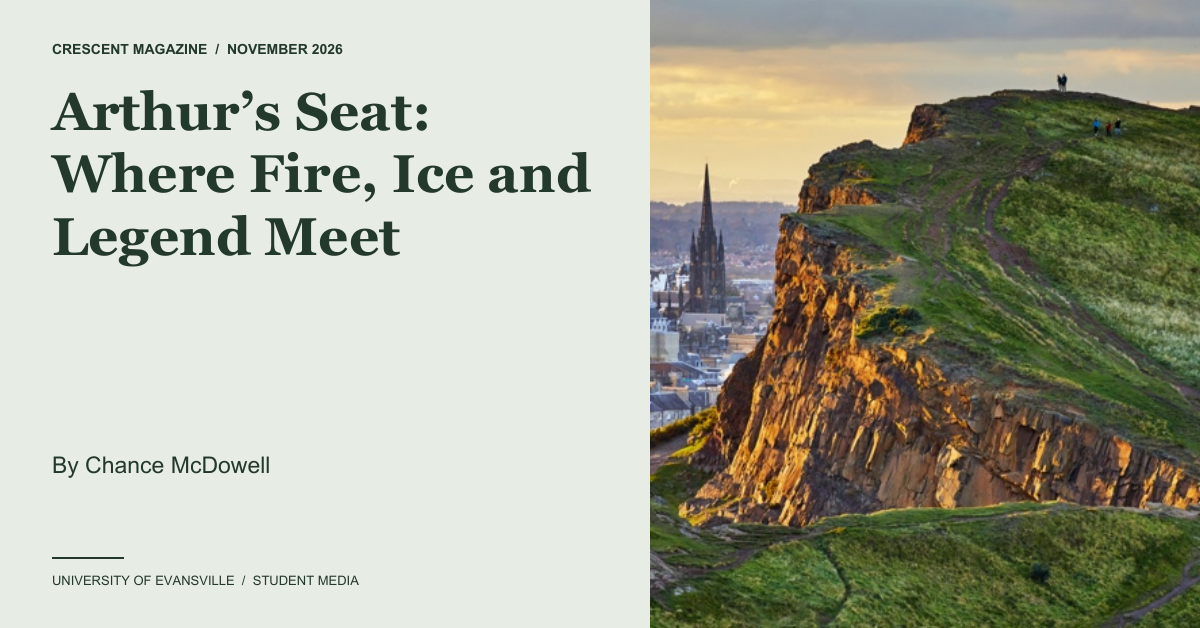
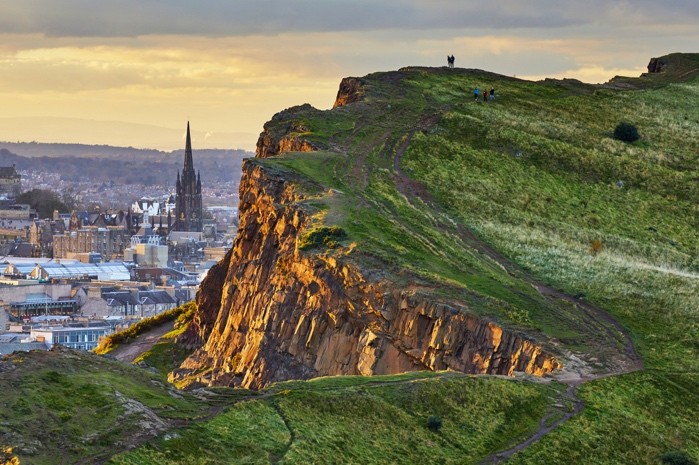
Rising above Edinburgh, an ancient volcano holds secrets of a prehistoric landscape and Scotland’s legendary past. Arthur’s Seat rises 251 meters above sea level, its rugged slopes overlooking the city, the Firth of Forth and the distant hills beyond. Today, it is a favorite destination for walkers and visitors, but beneath its grassy summit lies a story that began hundreds of millions of years before Edinburgh existed.

Arthur’s Seat is more than a hill. It is the remains of an ancient volcano, a geological monument shaped by fire and ice, and a place whose mysterious appearance has inspired centuries of myth and speculation. Its name evokes the legendary King Arthur, while its rocks preserve a history older than any human story.

“Arthur’s Seat.” U.S. News & World Report, https://travel.usnews.com/Edinburgh_Scotland/Things_To_Do/Arthur_s_Seat_23989/. Accessed 19 Oct. 2026.
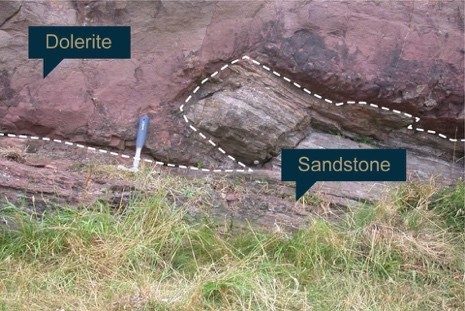
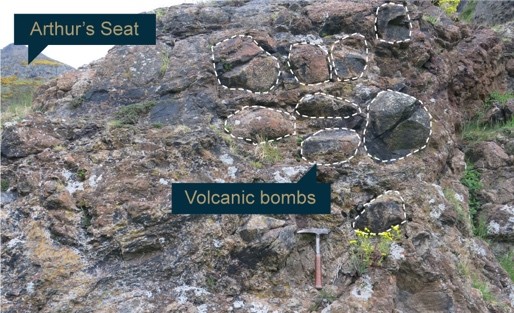
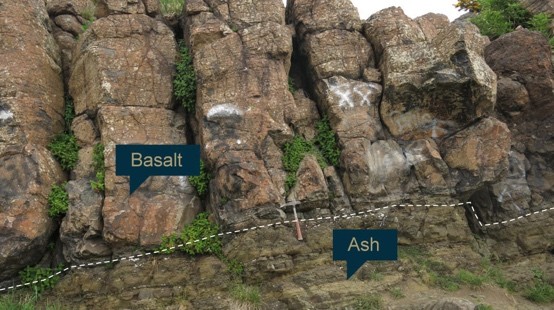
Around 340 million years ago, during the Carboniferous Period, the land that would eventually become Scotland lay much closer to the equator. The climate and landscape were vastly different from today’s, and volcanic activity was transforming the region. Molten rock rose through the Earth’s crust, erupted onto the surface, and spread across the surrounding landscape. Over time, these eruptions built the volcanic complex that would become Arthur’s Seat. Lava cooled and solidified into hard rock, preserving evidence of the powerful geological forces at work beneath the ancient landscape.
But the volcano’s story did not end when its eruptions ceased. Over millions of years, erosion gradually wore away the softer surrounding rocks, leaving more resistant volcanic material exposed. Later, during the Ice Ages, enormous glaciers moved across the landscape, carving valleys and reshaping the hillsides. The resulting landforms give Arthur’s Seat its distinctive profile, while nearby Salisbury Crags reveal further evidence of the region’s volcanic past.


Palamakumbura, Romesh. “A Walking Tour of the Geology of Arthur’s Seat.” *British Geological Survey*, https://www.bgs.ac.uk/discovering-geology/maps-and-resources/office-geology/geology-of-arthurs-seat/. Accessed 19 Oct. 2026.
The landscape we see today is therefore the product of two opposing forces: the heat and violence of volcanic activity, followed by the slow, relentless work of ice and erosion. What appears to be a natural hilltop is a surviving fragment of a much more dramatic ancient world.
Arthur’s Seat also played an important role in the development of modern geology. During the eighteenth century, Scottish naturalist James Hutton studied the rocks around Edinburgh, including those at Salisbury Crags. At a time when the age of the Earth was still widely misunderstood, Hutton argued that geological processes operated over immense periods of time.
The relationships between different rock layers helped him demonstrate that landscapes were not created in a single moment. Instead, processes such as erosion, sedimentation, heating, and the movement of molten rock continually transformed them. Hutton’s observations contributed to a revolutionary understanding of geological time. He argued that the Earth was far older than many people had imagined, with its history recorded in the rocks beneath our feet.
In this sense, Arthur’s Seat offers two very different kinds of perspective. From its summit, visitors can look out across a modern city shaped by human ambition. Below, the ancient rock tells a story of planetary change stretching back hundreds of millions of years.
A King Beneath the Hill?
Yet geology explains only part of Arthur’s Seat’s appeal. Its name opens the door to a much less certain history, one shaped by legend, folklore and the enduring fascination with King Arthur.
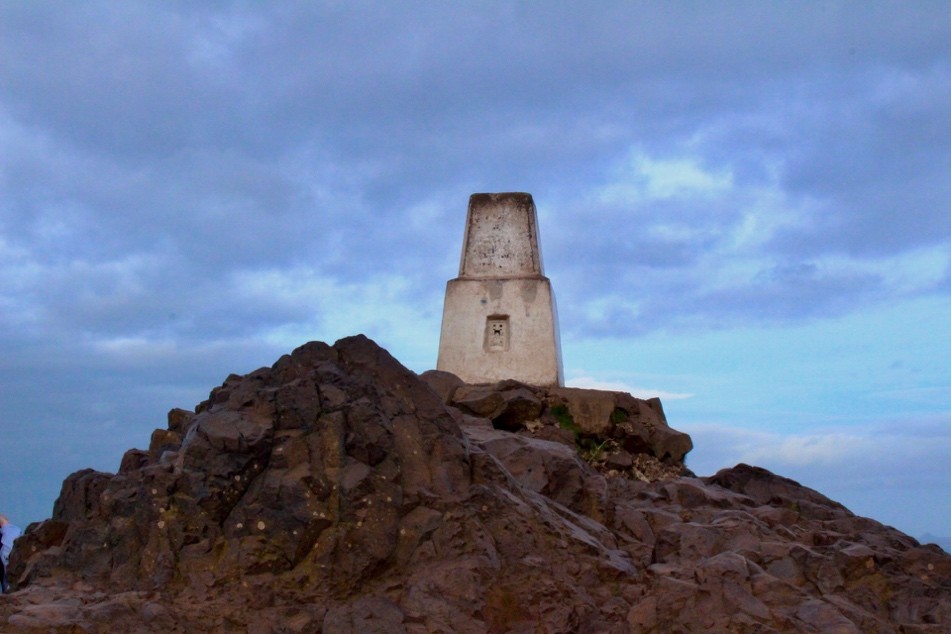
The origins of the name remain disputed. Popular tradition links the hill to the legendary British king, imagining it as a place from which Arthur surveyed his kingdom or, in some versions, a resting place where he lies waiting to awaken. The association is moving, though no conclusive evidence suggests the hill was named after the king. Other explanations suggest that the name may have linguistic roots in older Gaelic or Norse traditions. Proposed interpretations have linked it to a high place, a strategic position, or even the Norse god Thor. However, these explanations remain theories, not established facts.

Image taken by Chance McDowell
The uncertainty surrounding the name only adds to the hill’s atmosphere. Its commanding position above Edinburgh makes it easy to understand why people might have imagined powerful figures inhabiting or watching over it. Long before modern visitors climbed its slopes for exercise or panoramic views, the landscape was already a place of human activity and significance.
Archaeological evidence reveals ancient settlement, including hillforts and agricultural terraces, showing people lived and worked here thousands of years ago. The remains of these structures remind us that Arthur’s Seat has been more than a natural landmark: it has also been a place to inhabit, defend, and interpret.
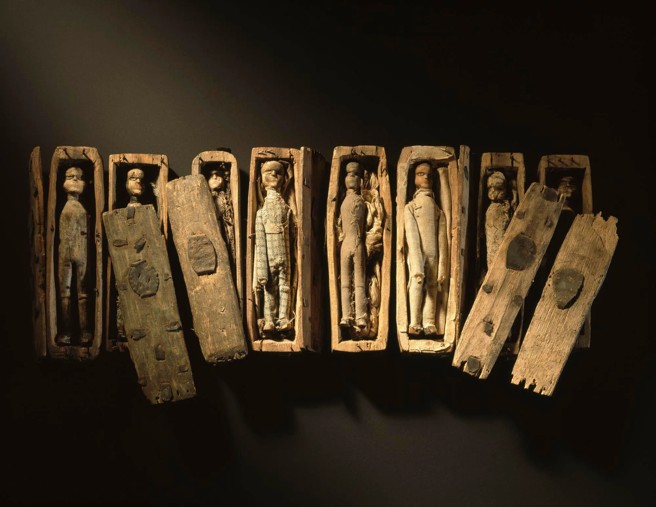
One of the hill’s strangest stories emerged in 1836, when a group of boys searching for rabbits discovered a small cave containing seventeen miniature wooden coffins. Each held a tiny carved wooden figure. Now preserved at the National Museum of Scotland, the objects remain an intriguing historical mystery. Their purpose has never been conclusively established. Suggested explanations have included symbolic memorials connected to the notorious murderers Burke and Hare, as well as ritual objects or other forms of commemoration. The truth remains uncertain, leaving room for speculation.

“National Museums Scotland.” National Museums Scotland, 2014, www.nms.ac.uk/discover-catalogue/the-coffins-found-on-arthurs-seat. Accessed 19 Oct. 2026.
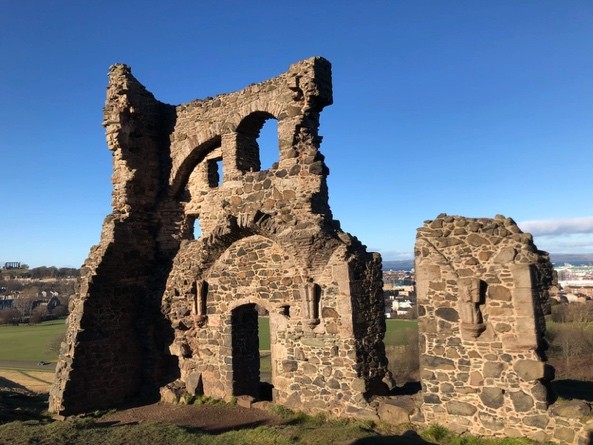
The coffins seem to capture something essential about Arthur’s Seat. Even in a landscape that scientists can explain through geology and archaeologists can investigate through physical evidence, unanswered questions remain. The hill encourages people to look for stories in its caves, rocks, and hidden corners. Perhaps this is why the association with King Arthur endures. The legend does not need to be historically proven to shape how people experience the place. Its dramatic silhouette, ancient foundations, and commanding views offer the perfect setting to imagine a world where heroes, gods, and forgotten histories still linger.

Davies, Gareth. “History Mystery - St Anthony’s Chapel, Edinburgh.” Edinburgh Expert Walking Tours, https://www.edinburghexpert.com/blog/history-mystery-st-anthonys-chapel-edinburgh. Accessed 19 Oct. 2026.
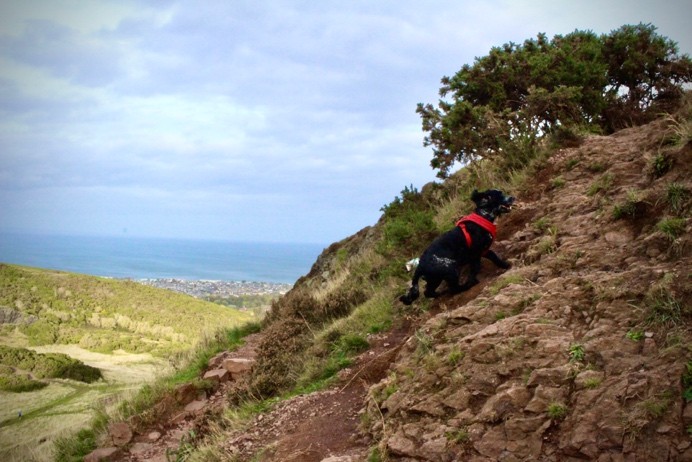
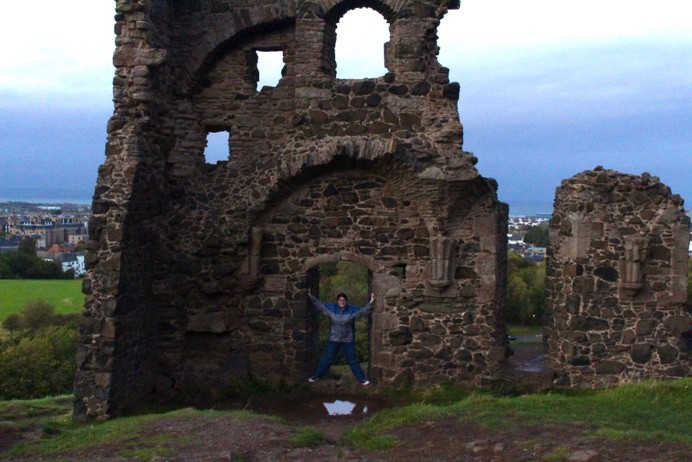
Image taken by Marc McDowell

While studying abroad at Harlaxton, I was given the terrific gift of traveling to Edinburgh, Scotland, for fall break with my father. We had both heard about Arthur’s Seat, but neither of us knew the backstory or understood its significance. While walking along the Royal Mile, we stopped into a local jewelry store and spoke with the owner. She asked us about good places to hike in the United States, as she loves the UK's outdoor scene but wants to travel more. After we gave her advice on where to go, she suggested we hike up Arthur’s Seat, saying it would be an “easy and less than 800-step hike.” We probably shouldn't have taken advice from a seemingly professional hiker, but we made it up the mountain regardless, and it was certainly worth the breathlessness and muscle pain.

My father and I at the top of Arthur’s Seat

Arthur’s Seat exists between fact and imagination. Its volcanic origins are written into its rocks, while its human history survives in archaeological remains and objects whose meanings are not always clear. Its connection to King Arthur may never be fully explained, but the legend has become part of the landscape’s identity. To climb Arthur’s Seat is to move through several layers of time at once: from the deep geological past, through the lives of ancient communities, to the stories people continue to tell today. The city spreads out below, modern and ever-changing, while the hill remains a reminder of forces and histories that stretch far beyond human experience. Its greatest mystery may not be whether a legendary king once stood on its summit, but why this ancient volcanic hill continues to capture the imagination. Perhaps the answer lies in the landscape itself, where fire, ice, history, and myth meet.
Garry, James. “Why Is It Called Arthur’s Seat? – The Cockburn Association.” The Cockburn Association, 5 July 2024, www.cockburnassociation.org.uk/history-blogs/why-is-it-called-arthurs-seat/. Accessed 19 Oct. 2026.
Goldmann, Stephan. “Arthur’s Seat in Edinburgh and the Seventeen Coffins in the Mountain.” MyHighlands.De, 11 Mar. 2025, www.myhighlands.de/en/arthurs-seat-edinburgh/. Accessed 19 Oct. 2026.
“History and Stories.” Historic Environment Scotland, 2019, www.historicenvironment.scot/visit/all/holyrood-park/history-and-stories/. Accessed 19 Oct. 2026.
“National Museums Scotland.” National Museums Scotland, 2014, www.nms.ac.uk/discover-catalogue/the-coffins-found-on-arthurs-seat. Accessed 19 Oct. 2026.
The Edinburgh Inquirer. “How Arthur’s Seat Got Its Name: Exploring Prehistoric Edinburgh.” Edinburghinquirer.Co.Uk, The Edinburgh Inquirer, 14 Feb. 2026, www.edinburghinquirer.co.uk/p/how-arthurs-seat-got-its-name-exploring. Accessed 19 Oct. 2026.